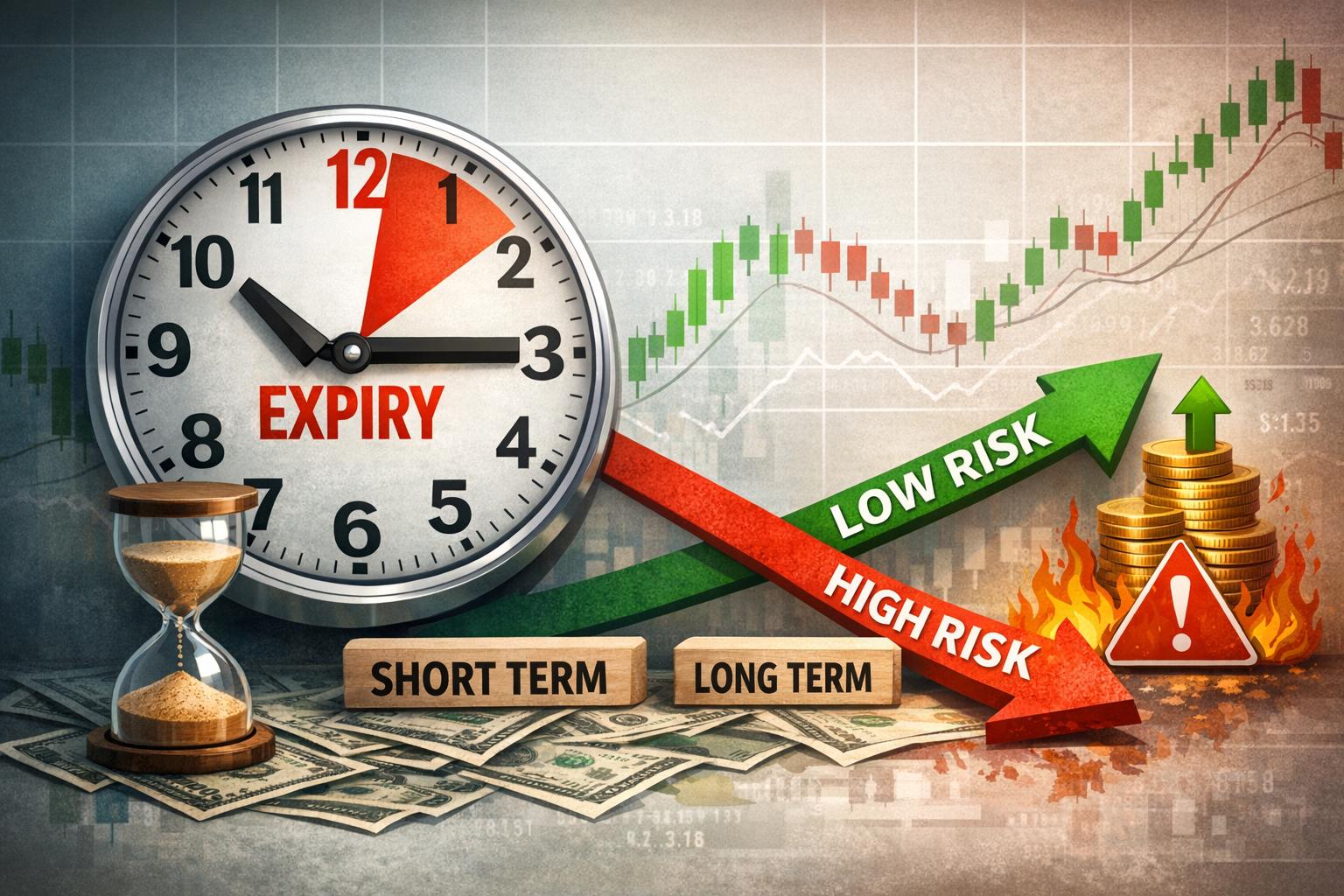
Understanding Expiry Times in Binary Options
In binary options trading, the expiry time is the predetermined moment when a contract closes and its outcome is decided. At expiry, the position is automatically settled based on whether the price of the underlying asset is above or below a specified strike level. Unlike other derivatives where positions can be closed manually before maturity, many binary option contracts resolve strictly at the fixed expiry, which makes the timing element central to the structure of the trade.
Expiry times can range from very short intervals, such as 30 seconds or one minute, to several hours, days, or even weeks, depending on the platform and regulatory environment. The defining feature is that the payout is fixed in advance. If the trader’s prediction is correct at the exact expiry moment, a predetermined return is credited; if incorrect, the invested amount is typically lost.
Although the payout remains constant regardless of the duration chosen, the probability distribution of potential outcomes changes as expiry length changes. Time influences how price fluctuations unfold and how different market forces affect the asset. Therefore, selecting an expiry duration is not merely a matter of preference; it is directly linked to risk structure, timing precision, and statistical expectation.
Short-Term Expiry and Market Noise
Very short expiry contracts, often referred to as turbo or short-duration options, usually settle within seconds or minutes. These contracts are highly sensitive to immediate price movements. In this environment, market noise plays a prominent role.
Market noise consists of small, short-lived price fluctuations caused by temporary imbalances between supply and demand, order execution delays, or automated trading strategies. These movements do not necessarily reflect broader economic information or identifiable trends. Because the expiry occurs quickly, there is limited time for a price move to stabilize or for a broader technical pattern to develop.
The reduced time horizon also affects trade management. In longer-duration instruments, temporary adverse movements may be offset if the broader analysis remains valid. In contrast, with a 60-second contract, even a minor counter-move can determine the outcome before the expected direction has time to materialize properly. As a result, execution timing becomes critical. Small entry delays, bid-ask spread differences, or momentary price spikes can influence final settlement.
From a statistical perspective, short expiries can increase dependence on variance. Even if a strategy has a theoretical edge over many repetitions, outcomes within a small sample may vary significantly because random fluctuations play a larger role over short intervals. This does not imply that short expiries are inherently unsuitable; rather, they demand precise timing methods and an understanding of micro-level price behavior.
Longer Expiry and Time for Adjustment
Longer expiry durations allow price development across a broader timeframe. A contract lasting several hours or days provides opportunity for identifiable trends, technical formations, or macroeconomic factors to influence price direction. Traders who rely on support and resistance zones, moving averages, or trend continuation patterns often find that these elements require time to unfold.
With more time available, a trade has greater capacity to absorb short-term volatility. For example, if a price briefly moves against the predicted direction, it may still recover before expiry if the underlying trend remains intact. This extended timeframe can reduce the relative impact of small fluctuations compared to very short contracts.
However, the additional time also introduces exposure to more external variables. Scheduled economic releases such as employment reports, inflation data, or interest rate announcements can cause sudden shifts in volatility. Unscheduled developments, including geopolitical events or unexpected corporate announcements, may alter price trajectories significantly before the contract expires. Therefore, longer durations distribute risk across a wider range of possible inputs.
Traders using longer expiries often monitor macroeconomic calendars and broader market sentiment to anticipate potential volatility spikes. In this context, time provides flexibility, but it also increases uncertainty related to unforeseen information.
Volatility and Expiry Selection
Volatility measures the degree of price fluctuation within a given timeframe and is central to expiry selection. The interaction between volatility and time influences how far and how quickly prices may move relative to the strike.
In high-volatility environments, short expiry contracts may experience rapid price oscillations within seconds. These movements can create opportunities, but they can also increase unpredictability. A sudden spike in either direction may determine the outcome regardless of prior analysis. Consequently, when volatility is elevated, the randomness of very short contracts may intensify.
By contrast, in low-volatility conditions, price ranges may remain confined. In such cases, short expiries may result in minimal movement between entry and settlement. This can make outcomes highly dependent on fractional price changes near the strike level. For longer expiries, low volatility may reduce the likelihood of meaningful directional progress, potentially limiting the statistical edge of trend-based expectations.
Volatility indicators, historical range measurements, and implied market expectations derived from related derivatives markets can assist in estimating potential movement. The key consideration is how far the asset is likely to move within the selected expiry window rather than simply how active the market appears.
Probability, Payout, and Risk Balance
Binary option payouts are fixed and predefined. For example, a contract may offer a return of 70–90 percent of the stake if the position expires in the money. Because the reward does not increase with the magnitude of the price move, the trader’s objective is strictly to finish on the correct side of the strike at expiry.
This structure highlights the importance of probability of success rather than the size of the move. Expiry length alters that probability profile. Short expiries concentrate the decision into a narrow time slice, where randomness and microstructure dynamics dominate. Longer expiries extend the timeframe, increasing the opportunity for analysis based on broader trends but also introducing exposure to additional unplanned factors.
To evaluate risk balance, traders often compare the required win rate implied by the payout with the historical performance of their strategy at different timeframes. For instance, if a payout requires a 55 percent win rate to break even, the selected expiry must consistently align with a methodology capable of achieving that success probability under comparable market conditions.
Strategic Alignment and Time Horizon
Expiry choice should reflect the time horizon of the analytical method used. Strategies based on short-term momentum, order flow, or rapid pattern recognition typically align with shorter contracts. Conversely, approaches built on daily trend analysis or macroeconomic interpretation require sufficient time for the anticipated movement to emerge.
Consistency between analytical timeframe and contract duration reduces structural mismatch. A divergence between the two may result in trades expiring before the anticipated movement unfolds or remaining exposed longer than the analysis supports.
Regulatory Considerations
Binary options are restricted or heavily regulated in multiple jurisdictions due to their fixed-risk and fixed-payout characteristics. Regulatory authorities in several regions have issued warnings about products offering rapid expiries combined with retail accessibility. Requirements regarding disclosure, leverage limits, and marketing practices vary substantially.
Before selecting any expiry duration, traders should understand the legal framework in their jurisdiction and review the specific contract conditions offered by the platform. Settlement methodology, pricing transparency, and dispute resolution procedures are particularly relevant for products that resolve at a single fixed moment.
Conclusion
Expiry times are a fundamental component of risk management in binary options trading. Short durations increase sensitivity to immediate price changes and statistical variance, while longer durations allow broader analytical factors to influence outcomes but introduce exposure to additional events. Evaluating volatility, aligning strategy with timeframe, and understanding the probability requirements implied by fixed payouts contribute to a structured approach to expiry selection.
This article was last updated on: March 1, 2026

 Exotic Binary Options
 Short binary options
 One touch/ no touch options