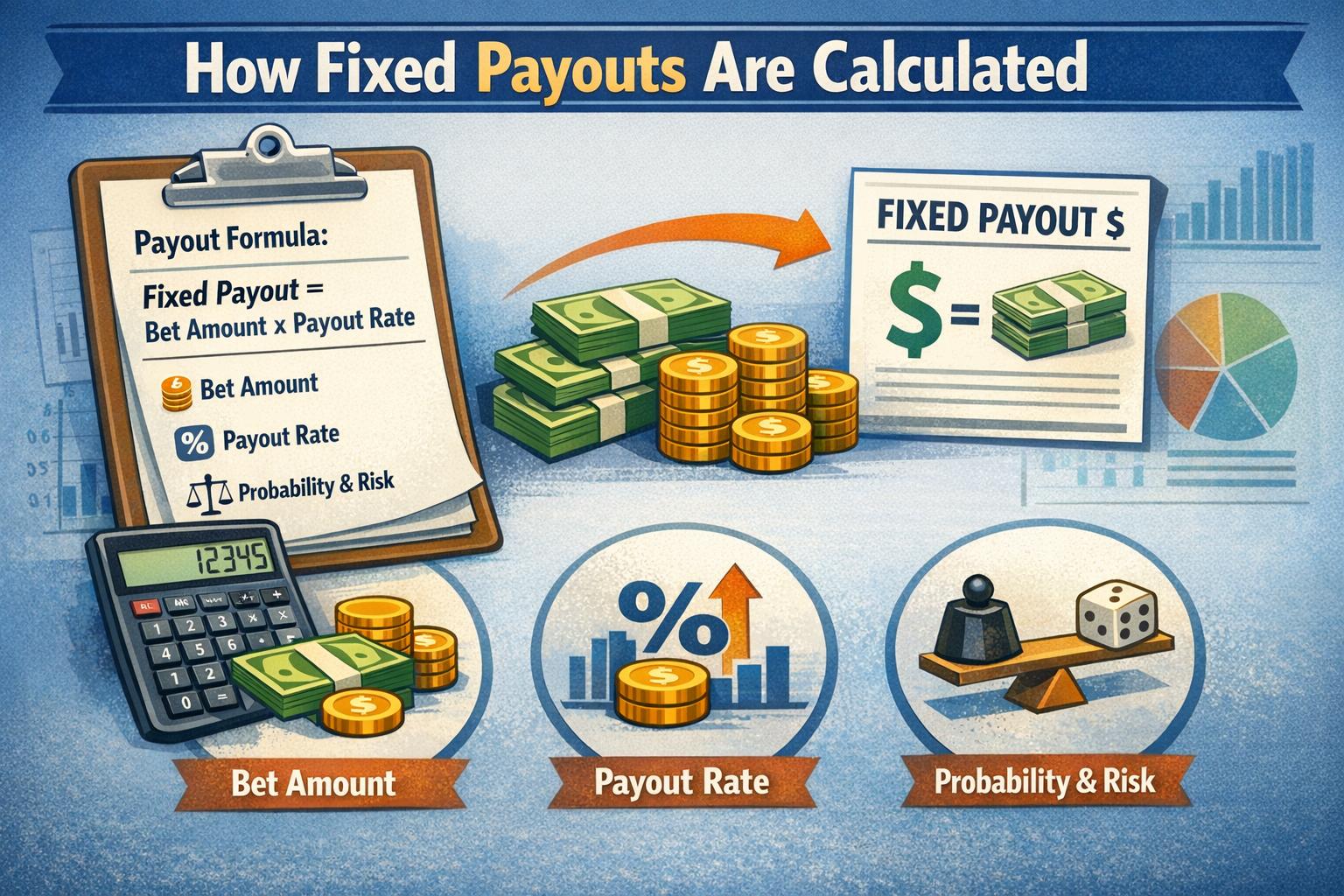
In binary options trading, the return structure is predefined. Unlike variable-payoff instruments such as traditional options or spot market positions, a trader knows the potential gain or loss before entering a position. This predefined framework distinguishes binary options from other derivatives and makes payout calculation central to trade evaluation. Understanding how fixed payouts are calculated clarifies the risk–reward profile of each transaction and provides a basis for assessing long-term viability.
Basic Structure of a Fixed Payout
A binary option pays either a fixed profit or nothing at expiration. The trader selects a direction, typically predicting whether an asset’s price will close above or below a specified strike price at a predetermined expiration time. The outcome is binary because there are only two possible settlement results: either the condition is satisfied, or it is not.
If the contract expires in-the-money, the trader receives the original stake plus the predetermined profit. If the contract expires out-of-the-money, the trader forfeits the entire invested amount. The payout percentage is agreed upon at the moment the position is opened, and it does not change if the trader holds the contract until expiration.
For example, if a broker offers a 75% payout on a successful trade and the trader invests $100, the total return at expiration will be $175. This includes the original $100 stake and a $75 profit. The clarity of this arrangement allows for straightforward calculation of maximum exposure per trade.
Broker-Determined Payout Ratios
Payout percentages are established by the broker and can vary across assets, trading sessions, and expiration periods. These payout ratios reflect the broker’s pricing methodology and internal risk controls. The percentage displayed on the trading platform represents the net profit relative to the invested amount, not the total payment including the stake.
Volatility plays a substantial role in payout determination. When an underlying asset exhibits higher price fluctuations, the probability of rapid directional movements increases. To manage exposure, brokers may adjust payout percentages to reflect this heightened uncertainty. In certain cases, higher volatility can compress payout rates because the statistical distribution of short-term price changes expands.
Liquidity also influences pricing. Highly traded instruments such as major currency pairs or large-cap stock indices often maintain relatively stable payout ratios. Deep liquidity allows brokers to hedge positions more efficiently and reduce execution risk.
Timeframe is another critical factor. Short-duration contracts, such as those expiring within minutes, may have different payout structures compared to contracts with daily or multi-day expirations. The shorter the timeframe, the greater the emphasis on immediate price variability and short-term statistical probabilities.
Because payout ratios are broker-determined rather than standardized across exchanges, reviewing contract specifications before placing a trade is essential. Differences in payout percentages directly influence the mathematical break-even point.
Implied Probability and Pricing Logic
Each fixed payout contains an implied probability of success. From a mathematical perspective, the payout percentage defines the minimum win rate required to offset losses over a series of trades. This concept is central to understanding the economic logic of binary option pricing.
If a trader risks $100 and stands to gain $80 in profit from a successful trade, the break-even calculation can be expressed as:
Break-even win rate = Investment / (Investment + Profit)
Applying the numbers:
100 / (100 + 80) = 0.5556 or 55.56%
This means the trader must win more than 55.56% of trades to achieve a neutral long-term expectation, assuming consistent stake size and payout conditions. If the payout percentage were lower, such as 70%, the break-even threshold would rise further. Conversely, a higher payout percentage reduces the required win rate.
From a pricing standpoint, brokers structure payouts so that the implied probability embedded in the contract accounts for operational costs, hedging strategies, and margin considerations. The difference between the true statistical probability of the event and the implied probability embedded in the payout represents the broker’s edge.
In-the-Money, At-the-Money, and Out-of-the-Money Outcomes
The settlement outcome of a binary option depends entirely on the asset’s price at expiration relative to the strike price.
An in-the-money result occurs when the contract condition is fulfilled. For a call option, this means the asset closes above the strike price. For a put option, it means the asset closes below the strike price. In this scenario, the trader receives the predefined payout.
An out-of-the-money result occurs when the condition is not met. The option expires without value, and the entire stake is lost. There are no partial losses or proportional settlements in standard fixed-payout structures.
An at-the-money result occurs when the asset’s closing price equals the strike price. Some brokers treat this as a loss, while others refund the initial investment without profit. Policies vary, and the treatment of such cases should be verified in the contract’s terms.
Because settlement depends on the exact quoted price at expiration, minor price differences can determine the entire outcome. Understanding how the broker calculates the closing reference price is therefore important.
Early Closure and Adjusted Payouts
Some trading platforms provide an early closure feature, allowing traders to exit a position before expiration. In such cases, the platform calculates a current contract value based on the prevailing market price, time to expiration, and implied probability of finishing in-the-money.
The early exit value is typically lower than the maximum advertised payout because uncertainty remains regarding final settlement. As expiration approaches and the outcome becomes more statistically certain, the contract’s valuation may converge toward either full payout or minimal value.
This recalculated price reflects probability modeling rather than the original fixed percentage. Traders who use early exit functionality must recognize that the payout is no longer purely binary until expiration; it becomes dynamically priced according to market conditions.
Risk–Reward Balance
Because payouts are fixed, the risk–reward ratio is transparent at entry. A trader can immediately identify the maximum possible profit and the maximum possible loss. Unlike leveraged margin trading, there is no incremental loss beyond the initial stake.
However, the structure contains an inherent asymmetry. Losses typically represent 100% of the invested amount, while gains are less than 100% profit. This asymmetry means that a trader must maintain a win rate above the calculated break-even threshold to achieve consistent profitability.
Position sizing, payout comparison, and statistical evaluation play key roles in managing this structure. Even small differences in payout percentages can materially affect long-term outcomes when compounded over many trades. By calculating implied probability and understanding how brokers determine payout ratios, traders can make more informed decisions about trade selection and capital allocation.
A clear grasp of fixed payout mechanics enables a structured assessment of binary options contracts. While the outcome remains binary at expiration, the analytical process behind evaluating each trade depends on probability, pricing logic, and disciplined risk management.
This article was last updated on: February 23, 2026

 Exotic Binary Options
 Short binary options
 One touch/ no touch options