In the Money, At the Money, and Out of the Money in Binary Options
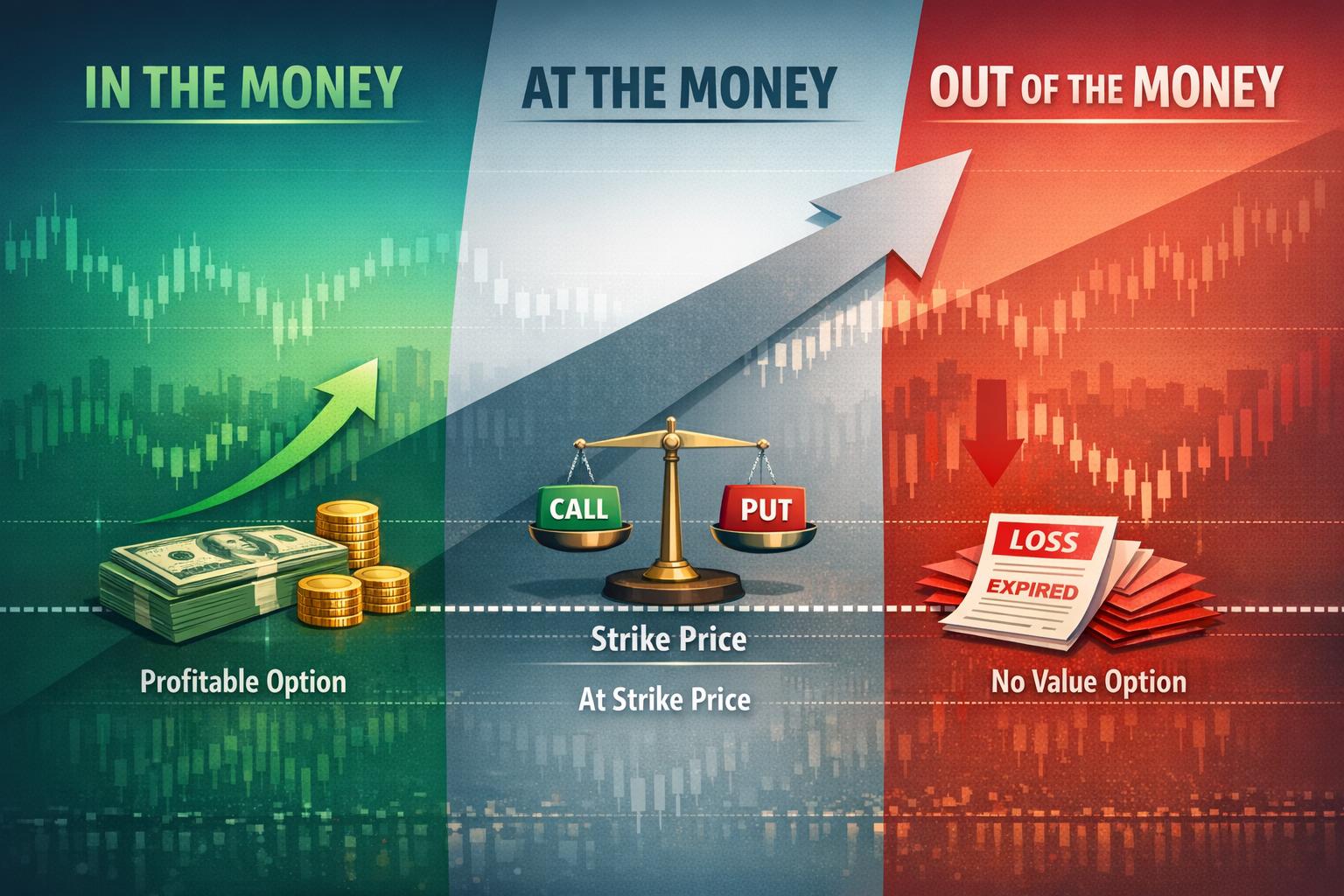
Understanding whether a position is in the money (ITM), at the money (ATM), or out of the money (OTM) is essential when trading binary options. These terms describe the relationship between the current market price of an underlying asset and the option’s strike price. Although the payoff structure of binary options differs from that of traditional options, the classification of moneyness follows the same core principle: it is determined by where the market price stands relative to the agreed strike level at a specific moment in time, usually expiration.
Binary options are structured around a fixed payoff. The trader selects a direction for the price movement of an underlying asset, such as a currency pair, stock, commodity, or index, and chooses an expiration time. If the predefined condition is satisfied at expiration, the contract pays a fixed return. If not, the trader loses the invested amount. Within this framework, the concepts of ITM, ATM, and OTM serve as objective measures of whether the trade meets its required condition.
In the Money (ITM)
A binary option is considered in the money when the asset’s price satisfies the contract’s condition at expiration. For a call binary option, the condition is met when the market price closes above the strike price. For a put binary option, the position is in the money when the market price closes below the strike price. The direction selected by the trader determines which side of the strike qualifies as a successful outcome.
The defining characteristic of a binary option is that the payoff does not increase as the price moves further beyond the strike. Once the condition is fulfilled, the payout is fixed according to the contract terms. For example, if a trader purchases a call option with a strike price of 100 and the asset closes at 101 or 120 at expiration, the payout is the same in both cases, as long as the final price remains above 100. The magnitude of the price move does not alter the return.
Before expiration, a position may temporarily be in the money as the market fluctuates. However, interim price movements do not guarantee a profit. Only the price at the exact expiration time determines the status of the option. This feature makes timing a critical variable in binary options trading, since a position that is ITM shortly before expiry can quickly revert to OTM with small price changes.
At the Money (ATM)
An option is described as at the money when the current market price is equal, or nearly equal, to the strike price. In binary options, this condition becomes particularly relevant near the expiration time. Because the outcome depends on whether the final price is above or below the strike, a price sitting directly at the strike creates uncertainty regarding settlement.
The treatment of at-the-money expirations depends on the contract specifications. Some providers define that if the asset closes exactly at the strike price, the trade results in a refund of the initial stake. Others may classify it as a loss, especially if the contract specifies that the price must close strictly above or below the strike. Traders must review the precise contractual terms to determine how ATM outcomes are handled.
In practice, prices frequently fluctuate by small increments, and even minimal changes in the final seconds before expiration can determine whether an option finishes ITM or OTM. As a result, an at-the-money situation often represents a transitional state rather than a final outcome. It reflects a balance between buyers and sellers at that price level, but it does not carry intrinsic monetary value within the binary structure unless the contract explicitly assigns one.
Out of the Money (OTM)
A binary option is out of the money when the asset’s price fails to meet the required condition at expiration. For a call option, this occurs when the price closes below the strike price. For a put option, it occurs when the price closes above the strike price. In both cases, the trader’s directional expectation is not realized at the decisive moment.
In standard binary contracts, an out-of-the-money outcome results in the loss of the invested capital. As with the payout in a successful trade, the loss is predetermined. The trader knows in advance the maximum financial exposure associated with the position. This predefined risk distinguishes binary options from leveraged instruments where losses may exceed the initial investment if not properly managed.
Similar to the ITM condition, a position may move in and out of the money multiple times before expiration. These temporary fluctuations have no effect on the final result unless the contract includes specific path-dependent features, such as touch or range conditions. In basic high/low binary options, only the closing price at expiration is relevant.
Time to Expiration and Price Dynamics
Time to expiration plays a central role in determining whether an option ultimately finishes ITM or OTM. Short-term contracts, which may expire in minutes or even seconds, are highly sensitive to immediate price volatility. In such cases, minor market movements can quickly shift the moneyness of a position. The shorter the time frame, the greater the influence of short-term supply and demand imbalances.
Longer-dated binary options allow more time for broader market factors to influence price direction. Economic data releases, corporate announcements, or macroeconomic trends may contribute to larger price movements over extended periods. However, the fixed payout structure still applies, meaning that regardless of duration, the option’s status at expiration determines the outcome.
The relationship between time and price movement also affects how traders evaluate probability. When a position is deep in the money with significant time remaining, there is still a possibility that adverse price changes could reverse its status. Conversely, a position that is slightly out of the money may still recover before expiration. Understanding this dynamic helps contextualize the current moneyness in relation to the remaining lifespan of the contract.
Comparison with Traditional Options
In traditional options markets, moneyness has implications for intrinsic value and the premium paid for the contract. An option that is in the money possesses intrinsic value, while an out-of-the-money option consists entirely of time value. The option’s price fluctuates continuously in response to changes in volatility, time decay, and the underlying asset’s price.
Binary options differ because the payout is fixed and the contract does not accumulate intrinsic value in the same manner. Instead of assessing how much intrinsic value an option contains, the trader evaluates the probability that it will expire on the correct side of the strike. Pricing is therefore closely linked to the statistical likelihood of the outcome rather than the extent of price movement.
This distinction simplifies certain aspects of decision-making. Traders do not need to calculate complex variables such as delta or gamma to determine potential profit. However, simplicity in payout does not eliminate risk. Since the result depends entirely on the final price at expiration, accurate assessment of direction and timing becomes central to the trading process.
Practical Implications for Risk Management
Recognizing whether a position is ITM, ATM, or OTM allows traders to monitor exposure within the predefined risk framework of binary options. Because both potential gain and potential loss are known at entry, capital allocation decisions can be structured accordingly. The trader can determine in advance the proportion of total capital committed to each position.
Although the binary payoff structure limits outcomes to two primary results, the probability of success is influenced by market conditions, volatility levels, and the choice of expiration. A clear understanding of moneyness classifications supports objective evaluation of these factors. It also reinforces the importance of reviewing contract specifications, especially regarding how at-the-money settlements are handled.
In binary options trading, the concepts of in the money, at the money, and out of the money provide a structured way to interpret price position relative to the strike. While the terminology mirrors that of traditional options, the implications are distinct due to the fixed payout design. By focusing on the relationship between price and strike at expiration, traders can better understand potential outcomes within the defined parameters of the contract.
This article was last updated on: February 23, 2026

 Exotic Binary Options
 Short binary options
 One touch/ no touch options